Key Takeaways
- Global supply chain management abroad can help you learn international networks and real-world operations.
- The US, UK, and Canada are popular because of program quality, employability, and strong industry links.
- Pick a course type based on your goal: Master’s, MBA, or diploma format.
- Compare fees and scholarship options before finalising your shortlist.
- Your results improve when your learning includes projects, tools, and job-focused practice in Global supply chain management.
Studying Global supply chain management abroad can make sense if you want international exposure, better role options, and stronger industry networks. The US, UK, and Canada are popular because they offer structured programs, modern learning, and strong links to companies that hire supply chain talent. In this blog, I will break it down in simple words, so you can choose the right country and course without confusion.
Why Is Global Supply Chain Management Worth Studying Abroad?
Global supply chain management is about how goods, information, and money move across countries—from sourcing to delivery. When you study abroad, you get closer to how international trade actually works, how large networks are planned, and how risks are handled.
You also learn to work with diverse teams and different business rules. That matters because supply chain work is often cross-border, even if your job role is based in one country.
Why are the US, UK, and Canada are Top Choices for Global Supply Chain Management?
These three countries stand out for a few clear reasons.
The US is known for strong industry partnerships, practical projects, and a wide variety of specialisations. Many programs focus on analytics, operations, and systems thinking, which helps if you want roles in planning, procurement, or strategy within Global supply chain management.
The UK is popular for shorter program durations, well-structured teaching, and strong links to international trade lanes. It can be a good choice if you want to complete your studies faster and enter the job market sooner with Global supply chain management skills.
Canada is attractive for its student-friendly pathways, strong demand in logistics and supply chain roles, and a steady job market in many provinces. Many students choose Canada for long-term career planning in Global supply chain management.
Types of Global Supply Chain Management Courses You Can Study

You will usually see three formats for Global supply chain management abroad:
Master’s programs
Good if you want deep domain learning and roles like analyst, planner, procurement specialist, or operations lead.
MBA with supply chain specialisation
Good if you already have work experience and want business leadership roles that include supply chain decision-making.
Graduate diplomas / postgraduate certificates
Good if you want a faster, skills-focused route and a more direct entry into operations and coordination roles.
Some students start with short, job-focused learning and later move into a longer supply chain management course for deeper coverage.
Top Supply Chain and Logistics Programs in the US, UK, and Canada
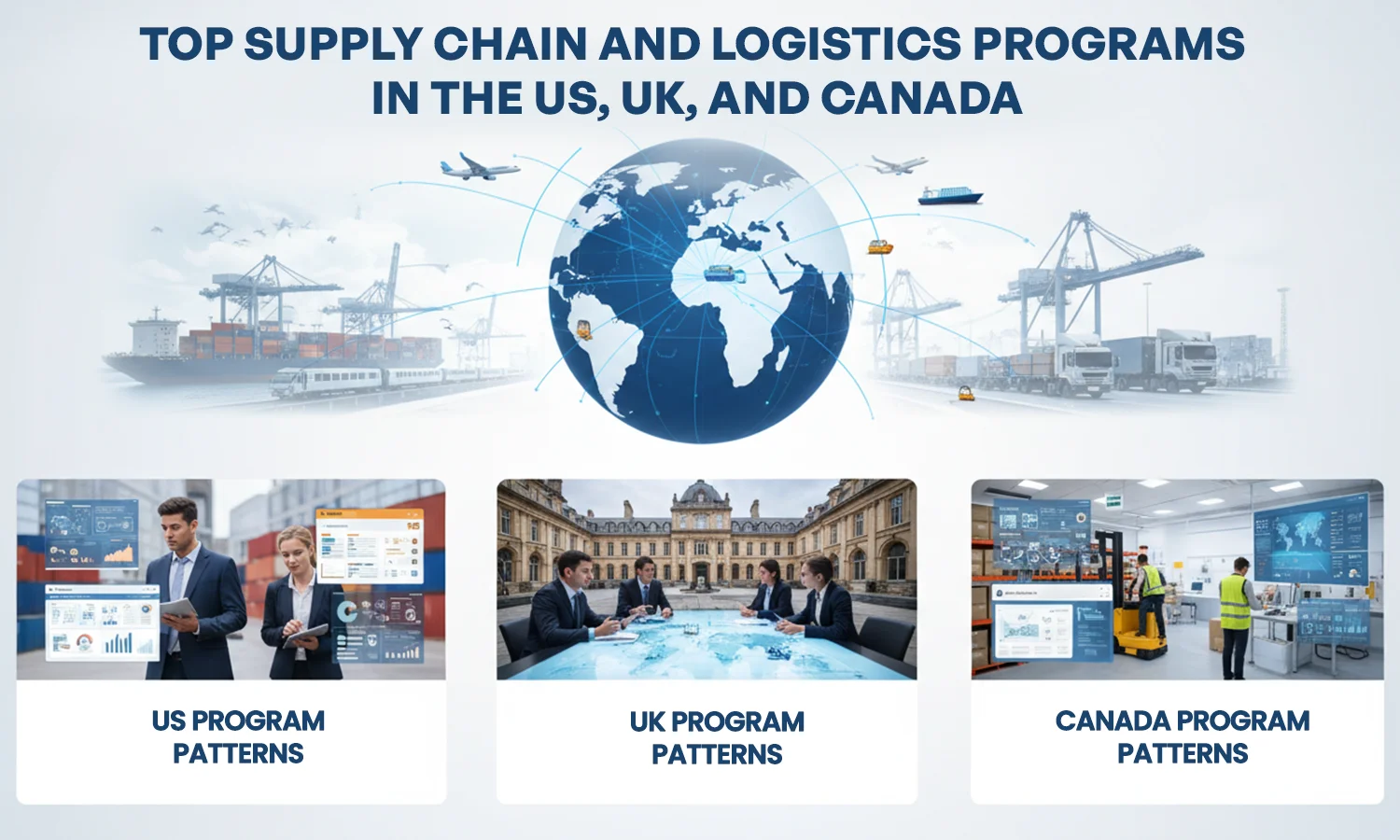
Instead of chasing “the best name,” focus on the program fit: course structure, projects, and the kind of roles graduates get. For Global supply chain management, here are the program types students commonly shortlist:
US program patterns
- Strong focus on analytics, planning, and process improvement
- Many courses include case work and industry projects
- Great if you want wider exposure across operations and strategy
UK program patterns
- Strong focus on international trade, operations, and logistics networks
- Often shorter programs compared to the US
- Good if you want faster completion and quicker job entry
Canada program patterns
- Strong focus on practical learning and employability
- Many options across universities and colleges
- Good if your goal is stable career growth in the Global supply chain management
If you are comparing options, add this simple filter: Does the program include real assignments, tools, and employer-facing projects? That matters more than fancy course titles.
Eligibility, Fees, and Scholarships for Global Supply Chain Management Courses
For Global supply chain management, eligibility is usually straightforward, but it varies by program type.
Common eligibility basics
- Bachelor’s degree (for most master’s and diploma programs)
- English language scores as required by the institute
- Some MBA programs prefer work experience
Fees and scholarships (simple view)
Fees depend on the country, institute, and course length. Scholarships are available in all three countries, but they usually depend on your grades, profile strength, and sometimes your work experience.
A smart approach is to shortlist 5–8 programs, then compare fees and scholarships side-by-side before you decide.
Career Opportunities After Studying Global Supply Chain Management Abroad
A good Global supply chain management program can open roles in many areas, depending on your skills and interests:
- Supply chain analyst and operations analyst
- Demand planning and inventory planning
- Procurement and supplier coordination
- Warehouse and distribution coordination
- Transportation and freight operations
Many students also add a supply chain management certification later to strengthen credibility as they grow into bigger roles. If you are exploring entry-level options too, some logistics courses can support quicker access to execution roles, especially if you want to start on the operations side first.
If you want deeper specialisation for senior tracks, an advanced supply chain management course can help once you have a base and some work exposure.
Conclusion
Studying Global supply chain management in the US, UK, or Canada can be a strong choice if you pick the right program type and match it to your career goal. The US is great for deep learning and specialisation, the UK often works well for faster completion, and Canada is a strong option for steady career building. If you want to plan your pathway clearly—course choice, job target, and skill focus—Transworld Academy can help you understand how the field works and how to prepare with confidence.
FAQs
Which country is best to study global supply chain management – the US, UK or Canada?
For Global supply chain management, pick the US for depth, the UK for faster completion, and Canada for steady career pathways.
What is the difference between a Master’s in Supply Chain Management, an MBA in Supply Chain, and a logistics course abroad?
A Master’s builds domain depth, an MBA builds business leadership, and a logistics course focuses more on execution and operations.
What are the basic eligibility requirements to get into a supply chain management course in the US, UK, or Canada?
Mostly need a bachelor’s degree and English scores; MBA programs may prefer work experience.
How expensive is it to study global supply chain management abroad, and are scholarships available?
Costs vary by country and course length, and scholarships exist in all three if your profile is strong.
What kind of jobs and salaries can I expect after studying supply chain management in these countries?
Roles depend on skills and experience; many start in analyst, planning, procurement, or operations tracks and grow with performance.