Key Takeaways
- Inventory management is a high-demand career path driven by e-commerce and global trade.
- Professionals must master mathematical models like EOQ and ABC Analysis.
- Stock valuation methods like FIFO are critical for financial accuracy.
- Success in 2026 requires proficiency in ERP software and AI-driven forecasting.
- Career growth leads from junior stock controllers to senior Supply Chain Directors.
Choosing the right inventory management course is a strategic move for your career in 2026. Whether you are starting from scratch or looking to upskill within a global shipping leader like the Transworld Group, the right education helps you master the balance between stock and cash flow.
Here is an industry-aligned guide to inventory management education for the current logistics landscape.
Is Inventory Management a Good Career Choice for Beginners?
Inventory management is a stable and rewarding entry point into the global business world. With the continued growth of e-commerce and quick-commerce in India, companies are constantly hiring professionals who can ensure products are in the right place at the right time.
For a beginner, this field offers a practical learning curve. You can enter as a junior analyst and learn the “physics” of a warehouse—how goods move, how they are tracked, and how data connects to physical reality. The path from the warehouse floor to the boardroom is well-defined, leading to roles like Demand Planner or Supply Chain Director.
Who Should Take an Inventory Management Course?
An inventory management course is essential for anyone dealing with the flow and storage of goods. Because inventory directly impacts customer satisfaction, these courses cater to a wide range of professionals:
- Fresh Graduates: Those looking to enter the supply chain domain need a foundational understanding to stand out.
- Warehouse Personnel: Managers and supervisors aiming to optimize storage space and implement digital tracking systems.
- Business Owners: Entrepreneurs who need to manage limited capital by ensuring they do not tie up too much cash in unsold stock.
- Specialized Support Roles: Accountants who handle stock valuation and production planners who ensure raw materials are available.
What You Will Learn in an Inventory Management Course
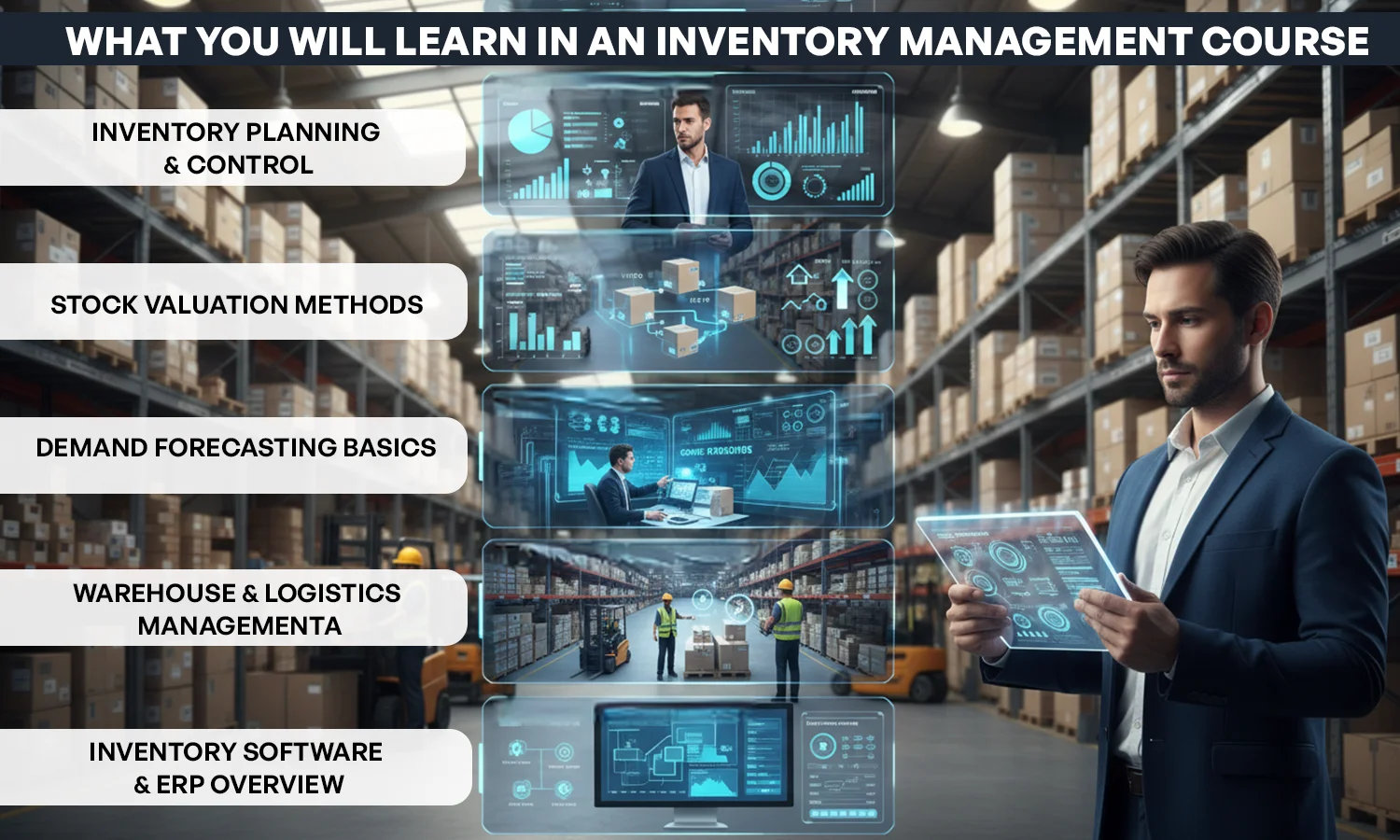
Modern curricula, such as those at the Transworld Academy of Excellence, shift focus from basic counting to high-level strategy. You will master five key pillars:
1. Inventory Planning & Control
You will learn to maintain the perfect balance of stock. This includes mastering Economic Order Quantity (EOQ) to find optimal batch sizes and ABC Analysis to prioritize high-value items. You also learn the math for calculating safety stock to survive unexpected supply chain disruptions.
2. Stock Valuation Methods
Inventory is a significant asset on a balance sheet. You will learn to value these assets for accurate financial reporting.
| Valuation Method | Industry Use | Financial Impact (Inflation) |
|---|---|---|
|
FIFO
|
Perishables, FMCG, Electronics |
Higher ending inventory value and reported profit.
|
|
LIFO
|
Non-perishable commodities (US GAAP)
|
Lower reported profit; provides tax advantages.
|
|
Weighted Average
|
High-volume identical items (Fuel, Grains)
|
Smoothes out price fluctuations for easier tracking.
|
The choice of method depends on the business type. Retail firms prefer FIFO to match the physical flow of goods, while bulk commodity traders often use the weighted average cost.
3. Demand Forecasting Basics
You will move from guessing to predictive analytics. This involves using historical data to predict future sales cycles and identifying “bullwhip effects” where small retail changes cause massive ripples in manufacturing.
4. Warehouse & Logistics Management
Efficiency starts with the floor plan. This module covers layout optimization to minimize travel time and multimodal transport to balance cost and speed in global shipping.
5. Inventory Software & ERP Overview
Modern inventory is managed through integrated digital ecosystems. You will gain experience with Warehouse Management Systems (WMS) and Enterprise Resource Planning (ERP) platforms like SAP S/4HANA or TallyPrime.
Inventory Management Tools and Software Covered in Courses
Modern courses focus on shifting from spreadsheets to real-time data. You will learn how software handles automated replenishment, where the system automatically generates purchase orders when stock hits a reorder point. Professionals also learn to build KPI dashboards using tools like Power BI to track inventory accuracy and turnover rates.
Build a Strong Career by Choosing the Right Inventory Management Course
For those starting in India, entry-level salaries typically range from ₹3.5–5 Lakhs per annum. However, as you master automated systems and move into specialized management, salaries at top logistics firms can reach ₹15–25 Lakhs+.
The goal is to choose a course that matches your career stage, from foundational vocational certifications for beginners to global standards like the CPIM for professionals.
FAQs
What is an inventory management course?
It is a professional program that teaches you how to track, manage, and optimize a company’s stock. It covers everything from physical warehouse operations to digital forecasting and financial valuation.
What skills do you need for inventory management?
You need a mix of analytical skills for demand forecasting, attention to detail for stock accuracy, and technical proficiency in WMS or ERP software.
What jobs can I get after an inventory management course?
Common roles include Inventory Analyst, Warehouse Manager, Demand Planner, and Logistics Coordinator.
What is the salary of an inventory manager in India?
In 2026, the average salary for an inventory manager in India is approximately ₹18.4 Lakhs, with senior roles at top logistics firms exceeding ₹30 Lakhs.